Where the Checkpoint Sits
Xaira breaks two years of silence with a progressable antibody lead in seven weeks and a GPCR antagonist where conventional discovery had failed. Plus: the first Methods Check tests the seven-week claim, the UK moves health-AI oversight to after launch, a chemistry agent ignores its own error and keeps going, ARPA-H sets out to remove trial phase gates, and the Onion Desk.
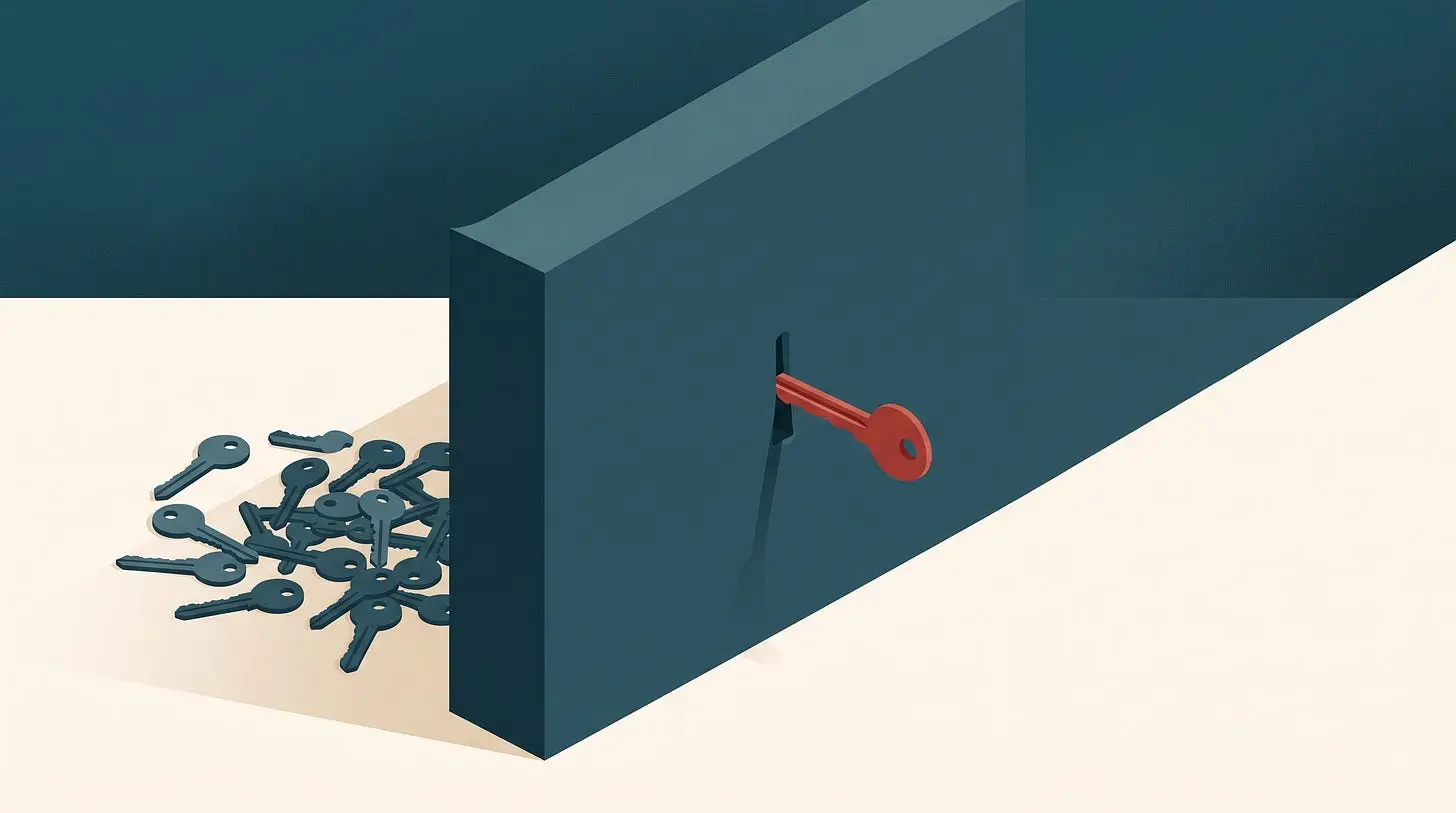
This is the full October 6 briefing, reproduced here in its entirety, and the first in the new format: The Brief up top, a Methods Check that tests one claim, and a single prediction tracked on the public scorecard. This week’s theme: the argument moved from how good the model is to where the checkpoint sits. Xaira’s disclosure is about designing antibodies that survive the developability gate, which is where most hits die. ARPA-H is funding a program to take the phase gates out of clinical development. The UK accepted a regulatory package that watches AI after launch rather than only before it, and the week’s sharpest analysis argued that an AI agent’s mistake only matters depending on how many checkpoints it survives. All four turn on the same question of who or what still stands between a wrong answer and a decision.
The Brief
- Xaira put numbers on de novo antibody design — a progressable lead in seven weeks, plus a GPCR where conventional discovery had already failed. Read the caveats before the headline. (Lead Story)
- The US government is funding the removal of trial phase gates. If SURPASS lands, your development plan’s structure is negotiable. (Quick Signals)
- The UK will regulate health AI by watching it after launch, not only before. Expect that logic to migrate toward drug-development AI. (On Our Radar)
- Before you buy an agentic platform, ask where it stops. The failure mode this week wasn’t a bad model, it was an unchecked one. (On Our Radar)
Xaira shows its hand: two antibody campaigns, one seven-week lead
Model releaseWhat happened — Xaira Therapeutics, which launched in 2024 with $1 billion and then went quiet, disclosed its X-Design antibody platform and the first two programs built on it, XA-1 and XA-4. CEO Marc Tessier-Lavigne told Fierce Biotech that the focus has been “a model that can design antibodies that are drug-ready from the start,” and that both candidates are headed for human studies on an undisclosed timeline.
Why it matters for deals and strategy — The competitive claim here is narrow and therefore useful. Most de novo design work reports binders. Xaira is reporting molecules that cleared humanness, polyspecificity, thermal stability and HIC in a single design pass, with one further round for cross-reactivity, which are the properties that normally eat months of hit-to-lead and humanization after the AI step is done. For a BD lead, that reframes what an AI antibody partnership buys. It isn’t faster hit-finding, which is already cheap; it’s removal of the optimization tail between a hit and something a committee will progress.
XA-4 is the result with the bigger payoff. Two naive VHH library campaigns, four rounds of selection each, plus a llama immunization campaign, all failed to produce functional binders against this GPCR. A 60,000-design library then produced a cross-reactive, developable antagonist. That is an argument that design can open targets pipelines currently route around, which changes which targets are worth in-licensing as well as how fast they move.
Xaira also said it is in active discussions about turning X-Design on partners’ targets, and declined to discuss its cash position.
My read — Seven weeks is a real number and it measures the wrong interval for anyone buying this. The clock starts after the epitope was chosen and the reagents were made, which is the part that stalls programs. What Xaira has shown is that once you know exactly what you want to bind, the molecule stops being the bottleneck. That’s worth something, and it isn’t the thing most partnerships are stuck on.
XA-4 is the better result and Xaira buries it. A GPCR that defeated two library campaigns and an immunization, then yielded a cross-reactive antagonist from a 60k design library, says something about target selection rather than speed. If that generalizes, the in-licensing filter changes: targets get rejected today because antibody discovery against them has failed, and that reason stops being automatic.
The weak point is “progressable.” Xaira coined it, set the criteria, and scored itself against them. Expect every AI antibody company to adopt the word within two quarters, at which point it means nothing. The useful second-order effect is contractual. Partners who take this seriously will start writing developability endpoints into collaboration milestones instead of accepting binding affinity as the gate, and that is a change you can observe in deal terms rather than in blog posts.
What I’d ask — How many program targets has X-Design Vega run against in total, and how many produced a progressable binder on the first pass? The denominator is the whole claim.
If we brought you a target, who sets the developability criteria and who adjudicates whether a molecule met them? A platform deal where the vendor grades its own output is not a deal I’d sign.
Sources: Xaira Therapeutics · Fierce Biotech
Xaira’s seven-week lead, tested
The claim — Xaira: X-Design Vega produced “a progressable molecule that was simultaneously human-like and developable in 3 weeks of wet lab experiments,” with “the entire experimental process from DNA synthesis to lead molecule” taking seven weeks for XA-1.
The evidence — 182 VHH sequences designed zero-shot against a chosen epitope. SPR screening against human and surrogate targets gave 25 initial hits, 18 confirmed binders after QC (a 10% binder rate), 9 with high-quality kinetic fits. Best molecule: 17 nM against the human target, 83 nM against cynomolgus, passing PAIA-OVA, CEX, HEP, BVP, thermal stability and HIC with a high OASis humanness score. One further optimization round for surrogate cross-reactivity produced the preclinical lead.
What the claim does not cover — The clock starts at DNA synthesis. Antigen production, reagent preparation and epitope selection were complete before the campaign began, which Xaira states. Xaira gives no duration for the optimization round, so the four weeks between the three-week binder and the seven-week lead is my subtraction, not their figure. There is no parallel conventional arm on XA-1, so “faster than traditional” compares to industry norms rather than to a control. The developability improvement is quoted as a 3x gain in human-like sequences meeting all criteria versus a baseline model trained without proprietary data, an internal ablation rather than an external benchmark. n = 1 target for the speed claim. The source is a company blog post with a named corresponding author, no peer review and no preprint.
Verdict — Supported as written, oversold as read. Every number checks out against the post, and Xaira is unusually candid about the epitope and reagents being ready beforehand. But a single target, no control arm, self-defined criteria and no peer review mean this is a strong existence proof and not a rate. Treat it as evidence that the method can work, and ask for the denominator before treating it as evidence of how often.
Sources: Xaira Therapeutics

The UK will regulate health AI by watching it run
RegulatoryThe UK government accepted all 44 recommendations of its National Commission into the Regulation of AI in Healthcare, including staged “L-plate” authorisations that let tools into supervised use while real-world evidence accumulates, and continuous monitoring after deployment. A draft set of proposals is due before year-end, the full implementation plan by spring 2027, with MHRA work on classifying AI-enabled devices starting next year.
This covers medical devices, and how much of it transfers to drug-development AI is an open question. But the underlying move, shifting the burden of proof from a pre-market dossier to a monitored deployment, is the same one ARPA-H is making on trial design and the same one pharma buyers make when they approve an AI platform on a pilot. If you are building a validation package for a model that will sit in a regulated workflow, the question is shifting from what you showed at approval to what you are logging now.

An AI agent got a small thing wrong, then kept going
OpinionBioPharma Dive walked through a failure documented in a 2025 evaluation paper, in which a chemistry agent fed a tool a malformed molecular string, got an explicit error, tried to repair it with the same bad input, got a second error, then switched to a generic expert tool and returned a confident, wrong answer about a toxicity liability.
Srijit Seal of Human Chemical Company argues that the direction of the error matters more than its existence. A false positive wastes an assay. A false negative removes scrutiny from an unsafe compound. What lets either survive is the architecture around the model: “you can stop it at certain gates,” he says, calling it an engineering question rather than a research one. For anyone evaluating agentic platforms this quarter, that turns a vague safety conversation into an answerable one. Name the gates, name who holds the veto, and name what evidence the agent has to show before the next step runs.
Sources: BioPharma Dive

ARPA-H launches SURPASS to take the phase gates out of clinical development
ClinicalSURPASS comes with three companion projects — a phaseless design engine built on digital twins, a continuous inference engine, and an agentic operations layer, with STACK, COMMONS and CINCH handling site activation, national data infrastructure and patient-contributed data. The program manager told Axios it could halve timelines and cut costs tenfold.
Sources: Axios
AstraZeneca opens its Kendall Square R&D centre
Infrastructure570,000 sq ft, nearly 2,000 scientists, built with robotics, continuous automation and agentic AI across ten interconnected lab floors.
MHRA opens applications for AI Airlock phase 3
RegulatoryThe regulatory sandbox names post-market surveillance as its stated priority area. Apply by 31 October for the current review wave.
Everlywell rolls out Clairity Breast across its US network
Product launchThe first FDA-authorised AI that scores five-year breast cancer risk from a routine mammogram.
Real Chemistry launches MaestroHCP
Product launchBuilt with AWS to sit between a next-best-action engine and the media and CRM channels it feeds. The AI decisioning is optional.
What we’re watching
Xaira’s blog post promises “a systematic assessment of X-Design” in a future post, and that is the thing to wait for. I expect a preprint or peer-reviewed paper from Xaira within six months — by early April 2027 — reporting hit and progressability rates across at least five targets rather than two case studies. The early confirming signal is a bioRxiv submission or a conference abstract from the X-Design team, most plausibly at an antibody engineering meeting in the first quarter. What would prove this wrong: a partnership announcement with a large pharma arriving first, with no accompanying data release. If Xaira can sell the platform on two campaigns and an interview, it has no commercial reason to publish the denominator, and the systematic assessment quietly becomes a diligence document instead of a paper.

Pharma adopts rigorous new AI governance framework, declines to say what happens when it fires
A mid-cap drugmaker announced a comprehensive agentic AI governance policy this week specifying twelve mandatory human checkpoints, a named accountable owner per workflow, and full provenance logging. Asked what occurs when a checkpoint flags an agent’s output as unreliable, the company confirmed that the output is escalated to a review committee, which meets quarterly. The agent, meanwhile, continues.
Also this week
- Genentech parts ways with its global head of AI drug discovery
- Talus Bio releases Ptarmigan-1, a structure-free binding model
- FDA opens a clinical trial modernization office inside CDER
- Bessemer survey finds healthcare AI paying back 3.5x in about a year
- Ginkgo Datapoints and Apheris name AbbVie, argenx, Lundbeck and Takeda as founding members of an antibody developability consortium
- Genentech AI alumni launch Ortet with $500M
- AI and proteomics accelerate VAV1 molecular glue discovery
Disclosure
How this is made: Claude searches the week’s news, pulls the primary documents and writes the draft. I choose the stories, edit, and check every number against its source before publishing. This issue is a test run of a new format, and the opinion sections — My read, What I’d ask, the Methods Check verdict and the prediction — were drafted by Claude and edited by me rather than written from scratch by me. Mistakes in any issue are mine.
Conflicts: I work at TetraScience, which sells data and AI software to pharma and biotech companies. I flag any story involving TetraScience, its partners or its direct competitors, and I never use customer or internal information. I use Anthropic’s Claude to produce this newsletter and disclose that whenever Anthropic appears in an issue. Views are my own.
Sourcing: The lead story rests on a company blog post and an interview, not peer-reviewed work. The Xaira developability comparison is an internal ablation. SURPASS is at solicitation stage with no disclosed budget. The UK package covers medical devices, not drug-development AI. The agent failure in On Our Radar was documented in 2025; the analysis is this week’s.
Corrections: Errors get fixed in the post and noted at the top of the next issue. Reply to any email or message me on LinkedIn.
Format adapted from The Batch (DeepLearning.AI). Credit where it’s due — and worth subscribing to in its own right. Selected and reviewed by Igor Gridchyn, Ph.D. More at gridchyn.ai.
This issue’s prediction is tracked and scored in public. Prediction scorecard →
Help shape this newsletter — five quick questions, under a minute. Give feedback →