The Bottleneck Gets Priced
Biohub expands its virtual-cell effort to $1.8B with Google DeepMind, Isomorphic Labs, Meta and two U.S. agencies, and no drugmaker among the funders. Plus: the Methods Check counts how much of the $1.8B is new money, Rivercell raises $25M to build its own cell data, IQVIA starts selling the virtual trial, and the Onion Desk.
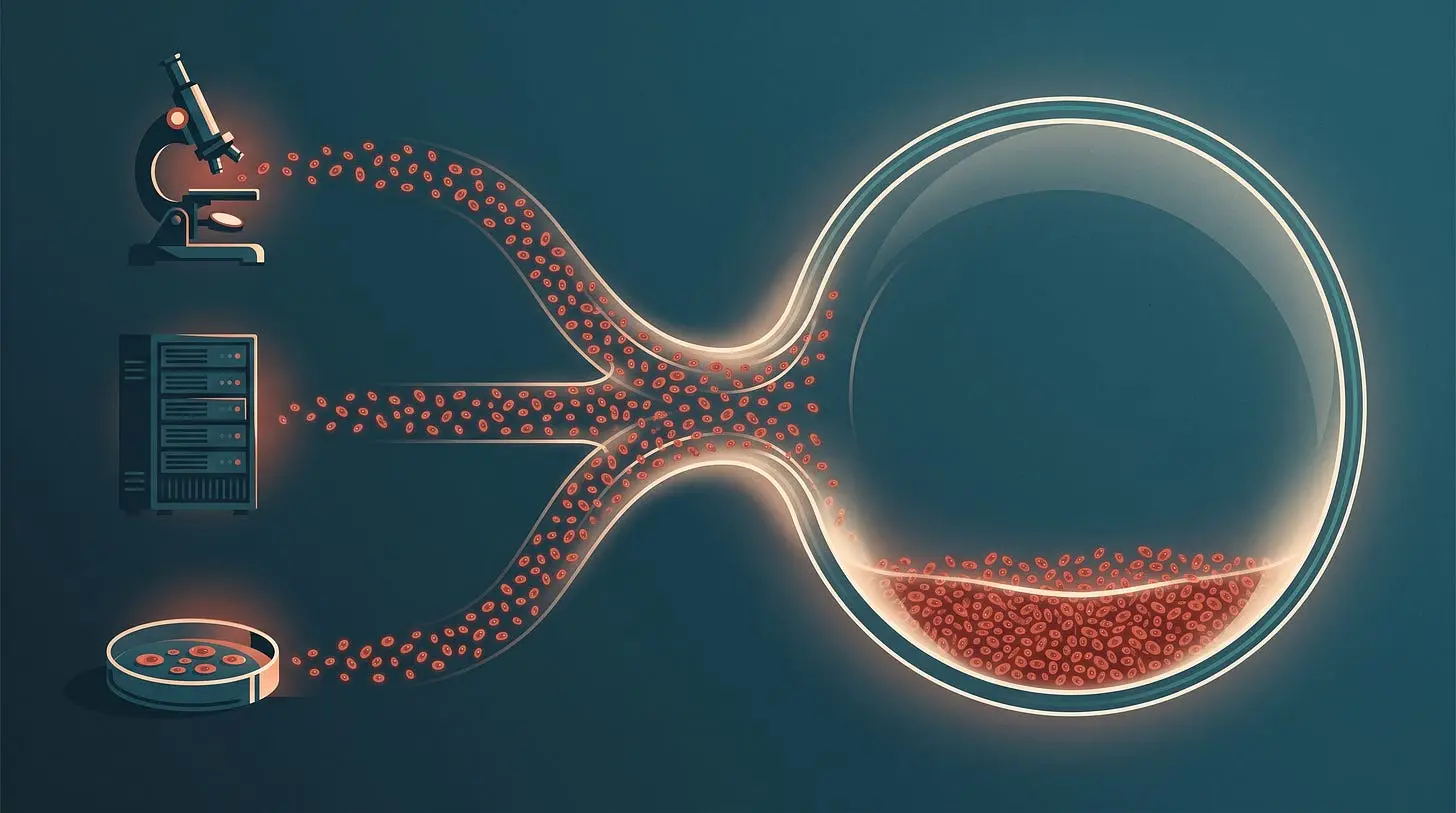
This is the full October 13 briefing, reproduced here in its entirety. This week’s theme: the bottleneck gets priced. The money went into the measurements AI models learn from, and into simulations that promise to replace some of those measurements. Biohub’s expanded Virtual Biology Initiative is the week’s biggest bet that data, not models, is what holds AI back in biology, and every private funder on it is a tech or AI company. A Paris seed round makes the opposite bet on proprietary cell data, IQVIA starts selling simulated trials built on its patient data, and the Methods Check asks how much of the $1.8 billion headline is new money.
The Brief
- Biohub’s virtual-cell coalition has signed up big tech, an AI drug-design company and two U.S. agencies, but no pharma company. (Lead Story)
- The “$1.8 billion” headline mixes new money with existing assets. Check the math before you quote it. (Methods Check)
- A Paris seed round bets that a startup’s own cell data beats open atlases. (On Our Radar)
- IQVIA now sells trial simulation. Ask how its accuracy claim was measured before you buy. (On Our Radar)
Biohub’s $1.8B bet that data, not models, is biology’s bottleneck
InfrastructureWhat happened — On Oct. 7, Biohub, the U.S. Department of Energy (DOE), the National Institutes of Health (NIH) and private partners announced a combined $1.8 billion in funding, data, compute and measurement technology. Google DeepMind, Isomorphic Labs and Meta are putting in $300 million together (Endpoints News; pharmaphorum). The aim is open, AI-ready data for models that predict how cells respond to drugs and genetic changes. Biohub’s head of science, Alex Rives, told Reuters he expects a first dataset in about a year, per eWEEK.
Why it matters for deals and strategy — Rives says existing datasets cover hundreds of millions of cells, while an accurate virtual cell may need billions and eventually trillions.
Open datasets shift the advantage to companies with their own interventional data and the lab capacity to validate predictions. GSK’s July deal with Relation for human cellular perturbation data, worth up to $110 million, is one example.
Biohub is also building the shared standards and common identifiers that partner datasets will plug into. The private funders are all tech and AI companies. The initiative hasn’t produced a universal virtual cell yet, so this belongs in 2027 budget planning.
My read — The most important name on this list is a missing one. Whoever sets the identifiers, data standards and benchmarks also defines what an “accurate” virtual cell means. Pharma is letting tech and AI companies write that definition.
Second, this squeezes every startup whose pitch is “we have lots of cell data.” A free, government-backed public resource sets a high floor. What survives is data tied to a decision: disease-relevant primary cells, patient-derived contexts, and a closed loop between predictions and lab results. Expect pitch decks to shift from “proprietary data” to “proprietary validation” within a year.
Third, temper the excitement. A 2025 Nature Methods study found that five single-cell foundation models and two other deep-learning models did not beat simple linear baselines at predicting the effects of genetic perturbations. More data is necessary, but it isn’t sufficient. Neuroscience is the precedent I know best: open brain atlases became shared infrastructure, and the value went to whoever asked sharp causal questions of them.
What I’d ask — To Biohub: Will funding members influence which cell types and perturbations get measured first, or get any lead time before public release?
To the tech funders: How much of the $300M is cash versus compute or in-kind data, and do you keep rights to models trained before release?
Sources: Endpoints News · pharmaphorum · eWEEK · Interesting Engineering · Fierce Biotech · Unite.AI · Nature Methods
Is it really $1.8 billion?
Industry dataThe claim — Biohub, DOE, NIH and partners are committing $1.8 billion to virtual biology.
The evidence — Per eWEEK and pharmaphorum, the total has four parts:
Biohub’s own commitment ($400M for measurement technologies, $100M for external research): $500M. Not new — announced April 29.
Google DeepMind, Isomorphic Labs and Meta, combined: $300M. New this week.
DOE, for measurement, modeling and computing: more than $500M over five years. New this week.
NIH, existing datasets and repositories from earlier federal funding: more than $500M. Not new — not newly pledged cash.
Total: about $1.8B.
Biohub says much of the value is in-kind: data, computation and measurement technology. Reuters, per eWEEK, reported that the figure mixes new investment with previously funded resources.
Verdict — Accurate as arithmetic, inflated as a headline. New commitments this week are $300M + more than $500M = more than $0.8B, or about 44% of $1.8B. The DOE share works out to just over $100M a year ($500M ÷ 5). Nobody has said how much of the tech partners’ $300M is cash. Before using it in a pitch or a board memo, call it “at least $0.8B in new commitments.”
Sources: eWEEK · pharmaphorum

Rivercell raises $25M to build its own cell data rather than borrow it
FundingParis startup Rivercell raised a $25M seed led by HV, with HCVC, Alven and Bpifrance Digital Venture. It will film living cells through each experiment in a larger Paris wet lab and train a world model of how cells respond to drugs and genetic changes. CEO Yann Fleureau co-founded Cardiologs; chief scientific officer Eric Durand previously led data science at Owkin.
Rivercell launched the same day as the Biohub expansion with the same goal, but keeps its data proprietary. It argues existing data often measures one aspect of a cell, at a single moment, in too few cell types. Startups selling proprietary data now have to show what theirs does that the open, government-backed resource won’t, before its first release.
Sources: The Next Web

IQVIA starts selling the virtual trial
Product launchIQVIA launched Life Science Models. They are built on NVIDIA Nemotron and AWS and connect molecular and treatment data with patient journeys and outcomes. Sponsors can use them to simulate studies and test endpoint, eligibility, dose and sample-size choices before enrolling anyone.
It’s the virtual-cell idea applied to trials, backed by IQVIA’s patient data. The company says 85% of predictions were “on target or clinically close” in an initial evaluation across 50 trials and 270 endpoints, without defining “clinically close” or saying whether the forecasts came before the trials read out. Buyers should ask for prospective validation. Regulators will have a say on the digital twins and synthetic controls IQVIA also lists.
Sources: IQVIA
Quick Signals
- Funding — Iambic set IPO terms that would value it at up to $805.8M (Reuters). Pricing is pending; the range sets a public price for an AI-native developer with a clinical asset.
- Funding — Undecimal Bio raised a €16M seed to deliver siRNA (small interfering RNA) beyond the liver, using AI agents to analyze its screening data (EU-Startups). Delivery beyond the liver is now the hard problem in RNAi.
- Infrastructure — GSK is committing more than $800M to a Pennsylvania hub that combines R&D and commercial production using digital technologies; construction starts next year (Fierce Pharma).
- Policy — The new PDUFA deal includes a dedicated pool of money to rehire FDA reviewers, trade groups say (Endpoints); reviewer capacity limits AI-heavy filings as much as any others.
- Papers — A Lancet Commission names malicious AI use as one of two health threats carrying extinction risk (CNN). The AI estimates are theoretical, but expect them to come up in debates over who gets access to biology AI models.
What we’re watching
By June 30, 2027, at least one top-20 pharma company will join Biohub’s Virtual Biology Initiative as a named funding partner. Today the private money comes entirely from tech and AI companies, which leaves drugmakers consuming standards they didn’t shape. The early signal would be a drugmaker contributing perturbation screens, joining the initiative’s data-standards work, or Biohub creating an industry membership tier. I’m wrong if the funder list still has no pharma company by mid-2027 and pharma keeps paying for proprietary perturbation data instead, through deals like GSK–Relation or startups like Rivercell.
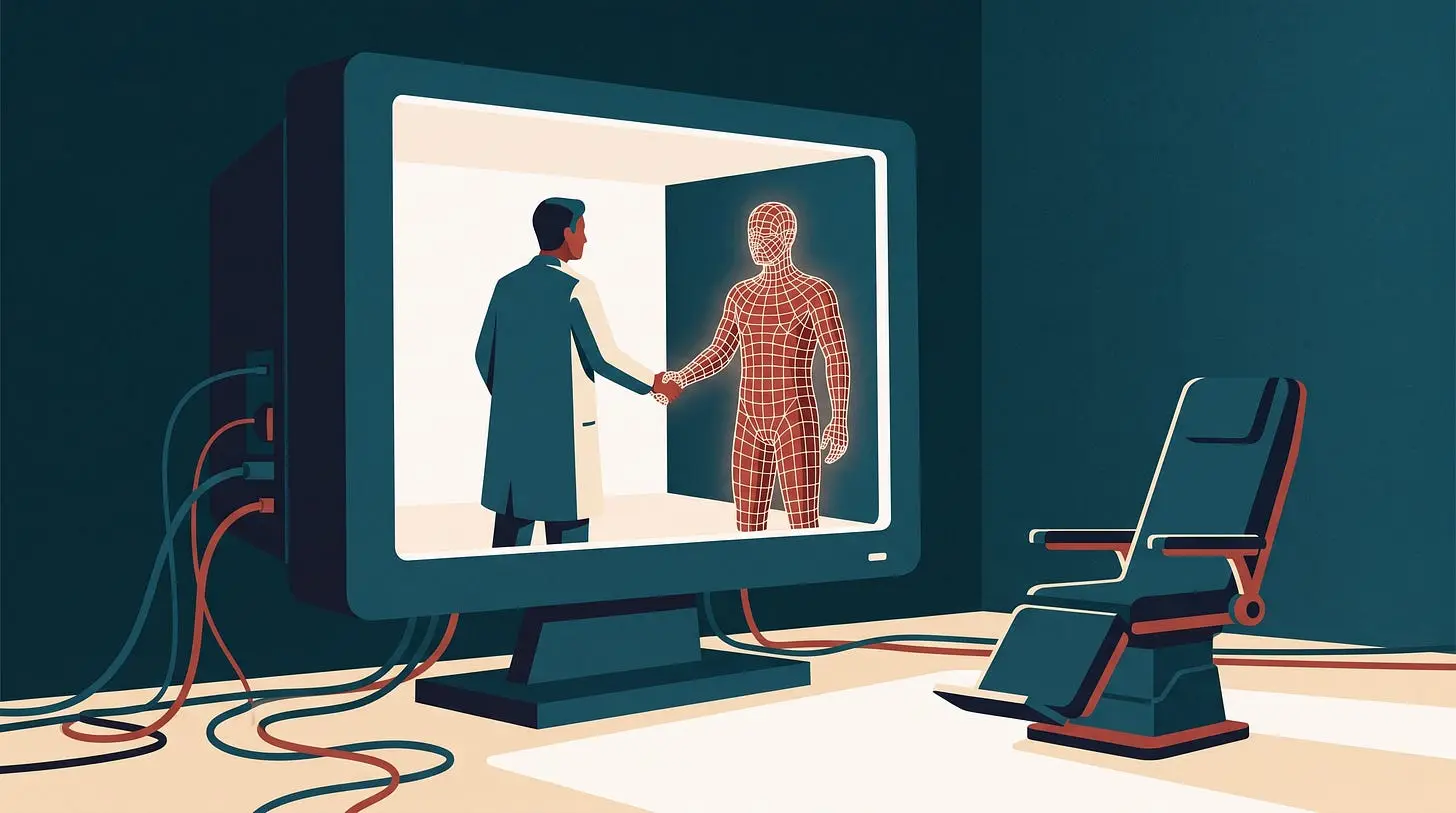
Biotech completes first fully virtual drug program, awaits virtual patients
A seed-stage startup announced that its lead candidate was discovered in a virtual cell, optimized in a virtual patient and cleared by a virtual trial, all in one quarter. Investors valued the company at a real $3 billion. “The only bottleneck left is reality,” the CEO said, adding that a reality-generation partnership will be announced next quarter.
Also this week
- Isomorphic in talks at a $40B+ valuation (Bloomberg)
- Chai signs GSK, its sixth pharma partner (Endpoints)
- Utah’s AI sandbox vs. FDA (STAT)
- FDA’s 2027 AI guidance plans (STAT)
- Cresset launches Flare AI Client
- CRIO’s AI eSource Builder
- Hankang’s AI small-molecule milestone (BioSpace)
Disclosure
How this is made: Claude searches the week’s news, pulls the primary documents and drafts the whole issue, including the analysis and opinion sections. I choose the stories, edit every section, and sign off before anything is published. Mistakes are mine.
Conflicts: I work at TetraScience, which sells data and AI software to pharma and biotech companies. I flag any story involving TetraScience, its partners or its direct competitors, and I never use customer or internal information. I use Anthropic’s Claude to produce this newsletter and disclose that whenever Anthropic appears in an issue. Views are my own.
Sourcing caveats: Endpoints, Bloomberg and STAT items are paywalled; I summarized them from the accessible portions and secondary coverage. All Biohub dollar figures trace to Biohub’s announcement as reported by the press; I did not see separate DOE or NIH statements. IQVIA’s accuracy figure is company-reported and unaudited. I did not review the Lancet Commission’s full text.
Errors get fixed in the post and noted at the top of the next issue. Format adapted from The Batch (DeepLearning.AI). Credit where it’s due — and worth subscribing to in its own right. Selected and reviewed by Igor Gridchyn, Ph.D. More at gridchyn.ai.
This issue’s prediction is tracked and scored in public. Prediction scorecard →
Help shape this newsletter — five quick questions, under a minute. Give feedback →