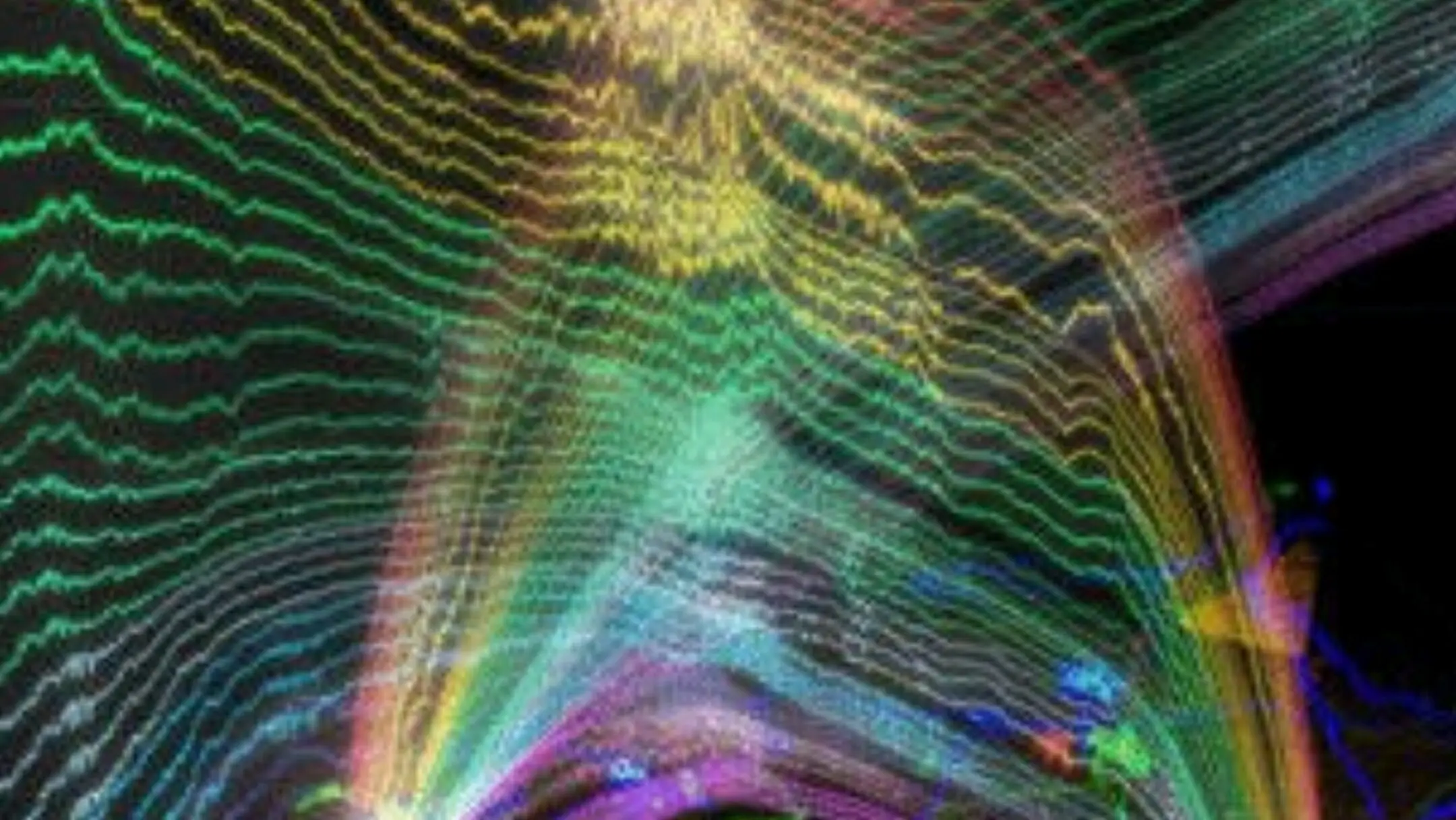
The cell that knows where you are
Somewhere behind your ear, a few thousand neurons are keeping track of the room you’re sitting in. Move your chair a few feet to the left and a different set of cells starts firing. Walk to the kitchen and the pattern changes again. This is not a metaphor. The brain assigns physical locations to specific neurons.
These neurons are called place cells, and they live in a curled-up structure deep in the temporal lobe called the hippocampus. They were discovered by John O’Keefe in 1971, who was poking electrodes into rat brains and noticed that some cells would fire only when the animal was in one specific corner of its cage. Forty-three years later, the discovery won a Nobel Prize.
What makes place cells extraordinary isn’t that the brain represents space — lots of brain regions do that. It’s that the representation is discrete and stable. A place cell that fires in the northwest corner of a maze on Monday will fire in roughly the same northwest corner when the rat returns on Friday. The cell has a kind of opinion about where “there” is.
What does a place cell actually look like?
Imagine you let a rat wander a circular table for ten minutes while you record from a single neuron. Most of the time, the cell is silent. Occasionally it fires a quick burst — ten, twenty action potentials in a few hundred milliseconds — and then goes quiet again. If you mark every firing on a map of the table, the marks don’t scatter uniformly. They cluster. They form a blob, a few centimeters wide, somewhere on the table. That blob is the cell’s place field.
Each place cell has its own field, in its own location. Together, a few hundred of them tile the entire environment, and the activity of the population at any moment encodes — with surprising precision — where the animal is. You can decode position from these cells the way you decode pixels from a sensor.
Move the red dot across the board. Each colored circle is the place field of a single neuron. When you enter a field, that cell fires — you’ll see a pulse and the spike count tick up. Linger in one place and a heat map of where you’ve been will build up below.
Notice how each cell has its own little territory. The cells don’t coordinate; they don’t know about each other. They simply fire when the rat — and you, by proxy — enter their preferred patch. With enough cells covering the floor, you can recover the trajectory just from the spikes.
This last fact is the entire premise of the next eight chapters. If we can read out position from a population of place cells in real recordings, we can do it from recordings of the brain replaying its own past — and that’s where things start to get strange.
Where this site shows raw electrophysiology — spike trains, rate maps, sharp-wave ripples — some examples are drawn from the Frank Lab’s openly published recordings so the visualizations can faithfully show what hippocampal data really looks like. The methods, decoders, and analyses described from Chapter 2 onward are my own work; the underlying paper is Gridchyn et al., Neuron 2020.