AI Gets an Owner
The FDA created a Deputy Commissioner for Technology and AI and gave the job to a quality-systems executive rather than an ML researcher — positioning AI oversight as a validation and change-control problem sitting above, and in tension with, the agency's own AI adoption. Plus: EMD Serono buys two AI-designed fertility programs from PostEra outright instead of licensing the platform, Panakeia's pathology AI holds up across hospitals and scanners, Insilico posts its first profitable half-year, and the Onion Desk.

This is the full September 15 briefing, reproduced here in its entirety. This week's theme: AI gets an owner. For most of the last three years, AI in life sciences has belonged to no one in particular — a capability everyone referenced and nobody signed for. This week, ownership started showing up in the paperwork: the FDA gave AI a named executive who sits above its product centres, EMD Serono took sole responsibility for two molecules an AI platform designed, Panakeia's pathology model had to perform across hospitals it didn't choose, and Insilico's half-year results show who is actually paying for AI-derived assets. The common thread is that AI stops being interesting once someone is accountable for it — and that is when it starts to matter.
The FDA Puts AI Above the Centre Directors
RegulatoryWhat’s new — The FDA has created a Deputy Commissioner for Technology and Artificial Intelligence, moving AI strategy into the commissioner’s office rather than leaving it inside CDER, CBER or CDRH individually.
What happened — On September 8, the FDA named Michael Davis to lead CDER, Karim Mikhail to lead CBER, and Bret Koplow to lead the Center for Tobacco Products, converting all three from acting to permanent appointments. Alongside them, Jared Seehafer was appointed the agency’s first deputy commissioner for Technology and Artificial Intelligence. CNBC had reported in August that HHS planned two new deputy roles — one for technology and AI, one for drugs — with Seehafer the leading candidate for the technology post; the drugs deputy role has not yet been formally announced.
How it works — Deputy commissioners sit in the Office of the Commissioner, one level above the product centres. Seehafer becomes the agency’s senior executive for technology, software and AI, setting FDA-wide strategy and priorities across two distinct jobs: the FDA as a user of AI (it launched its Elsa tool in June 2025 and, in December, agentic AI to help staff with meetings, pre-market reviews and report validation), and the FDA as a regulator of AI in the products and submissions it reviews. On background, Seehafer founded Enzyme, a quality and regulatory software and services company, and ran it for eight years through its acquisition; before that he led the combination-product regulatory consulting practice at Suttons Creek.
Key insight — The appointee’s background is quality management systems and drug-device combinations — not ML research, and not drug review. That suggests the agency sees AI governance mainly as a validation and change-control problem, which is how QMS people think about software.
Behind the news — The appointment adds a layer on top of guidance that already exists. The FDA published its first draft guidance on AI in drug and biologic development in January 2025, setting out a risk-based framework for assessing the credibility of AI models used in regulatory applications. In January 2026, the FDA and EMA jointly published ten principles for good AI practice across the medicines lifecycle, and said those principles will underpin future guidance in both jurisdictions. The appointments also follow a period of instability — Davis and Mikhail spent months trying to steady an agency that had started to capsize under former Commissioner Marty Makary, and the deputy-level placement reads as a sign that the administration wants AI handled as a cross-agency priority rather than centre by centre.
Why it matters — Sponsors running AI-enabled trials, digital endpoints or AI-assisted CMC have so far dealt with AI through whichever centre owned their product, each with its own interpretation. A single accountable executive creates a route to consistency across centres, and a single point of policy direction that no longer depends on centre culture. BD and regulatory leads should expect questions about AI in their submissions to start arriving in a more uniform vocabulary.
We’re thinking — Most coverage treats this as a signal that “the AI revolution is coming.” The more important structural fact is that the office encouraging the FDA’s own use of AI now also sets the direction for how industry’s AI is scrutinised — a real tension, since an office measured on internal adoption has little incentive to set a high evidentiary bar for AI that looks like the tools it is rolling out. There’s a second tradeoff: centralisation buys consistency, but it also makes AI policy easier to steer politically — reporting in August suggested some in the administration saw the new deputy roles as a way to exert more influence over the agency. Our practical read is that the Enzyme and QMS background will shape the questions sponsors get: expect scrutiny of model versioning, change control, audit trails and intended-use boundaries more than benchmark AUCs. Sponsors whose AI documentation looks like an ML paper rather than a validated-system file will feel this first. Two things will tell us whether this is a real office or a title: whether Seehafer gets dedicated staff and budget, and whether centre-level AI staff start reporting to him. Neither has been announced.
Sources: RAPS · BioSpace · CNBC · PharmExec

EMD Serono Buys Two AI-Designed Fertility Programs From PostEra Outright
M&AWhat’s new — A big pharma has bought AI-originated programs outright instead of licensing access to the platform that produced them.
What happened — PostEra said EMD Serono, the US and Canadian healthcare business of Merck KGaA, has acquired two of its fertility programs, built over two years on its Proton AI platform: small-molecule FSHR agonists for ovarian stimulation in IVF, and LHCGR agonists for male infertility and ovulation trigger. EMD Serono now has sole responsibility for worldwide development and any commercialisation. Both programs are still preclinical, and the announcement did not include financial terms.
Why it matters — Both receptors are already validated by biologics, but decades of work have produced little progress on orally bioavailable small molecules against them. That fits EMD Serono’s franchise well — its IVF portfolio (Gonal-f, Ovidrel, Cetrotide) is injectable, so an oral agonist would be a lifecycle and convenience play against its own products.
We’re thinking — An asset sale is the cleanest validation an AI platform can get, because the buyer carries the risk and there are no collaboration milestones to inflate. It also caps PostEra’s upside and reveals a strategy: design molecules against hard, biologically validated targets, then exit before the clinic. We’d like to see this model repeated more than another multi-target “strategic collaboration.”
Sources: PR Newswire
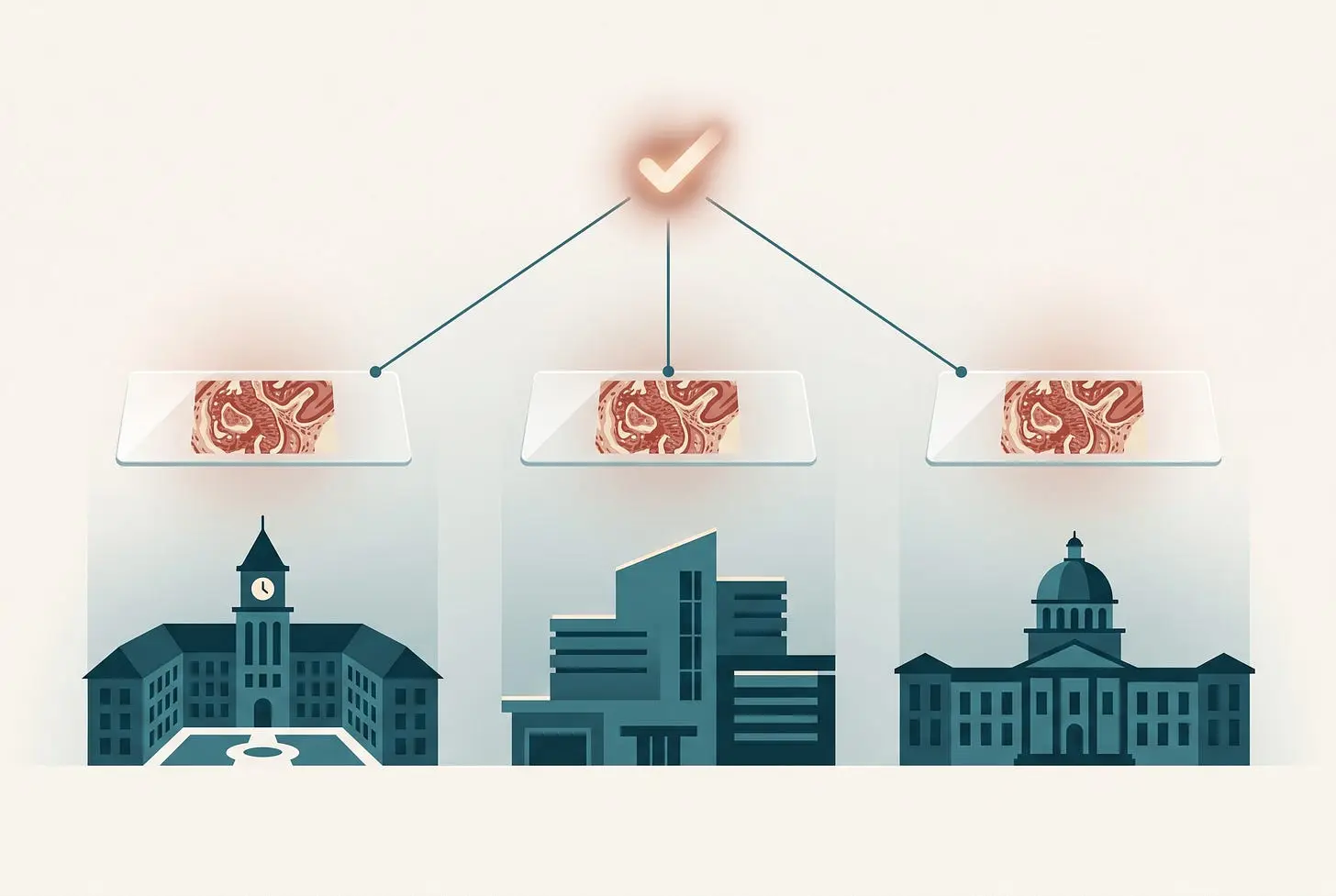
Panakeia’s Pathology AI Holds Up Across Hospitals and Scanners
PapersWhat’s new — An AI tool that reads breast-cancer biomarkers from routine slide images has published multi-site validation.
What happened — Panakeia announced a multi-site clinical validation study in Clinical Breast Cancer, covering PANProfiler Breast, a UKCA-marked device that calls ER, PR and HER2 status directly from routine brightfield images of tissue and cells. The company says performance was consistent across independent institutions, including when images came from different types of digital scanner.
How it works — The model infers molecular status from morphology on standard stained slides, so no extra lab assay is needed. For context, the company’s colorectal product has published headline numbers: in an earlier blinded real-world validation of 3,178 samples, PANProfiler Colon reached 92.69% positive and 94.05% negative agreement for MSI/dMMR. The breast release we reviewed doesn’t state equivalent figures, so read the paper before quoting any.
Why it matters — Pathology AI usually fails when it moves between sites — different stains, different scanners, and a quietly degraded model. Multi-site evidence is what makes a model’s results usable beyond the hospital that trained it. The broader platform is sold for research use in trial patient screening across more than 30 cancer types, which is where the pharma relevance lies.
We’re thinking — ER/PR/HER2 immunohistochemistry is cheap and entrenched, so replacing it in routine breast care is a weak business case. The stronger case is trial enrichment: pre-screening large archives of H&E slides for rarer biomarkers before paying for confirmatory testing. The breast study matters less as a product claim than as evidence that the platform generalises. This is company-announced, and we have not reviewed the full paper.
Sources: GlobeNewswire

Insilico’s Numbers Show Who Is Paying for AI Drug Discovery
Industry dataWhat’s new — Alongside dosing the first patient in its Phase III trial, Insilico put a full set of commercial and productivity figures on the record.
What happened — The company reported roughly $106 million in first-half 2026 revenue, up 287% year on year, and its first profitable half-year since listing, with adjusted net profit above $51 million. It attributed the result to out-licensing, co-development and R&D deals with partners including Eli Lilly, Servier, Takeda and SK Biopharmaceuticals. Insilico also said deals announced in 2026 total about $7.3 billion in contract value, and its major collaborations since 2021 total about $11 billion.
Results — As of late August, Insilico had nominated nine development candidates in the first nine months of 2026, a company record, and hit eight clinical milestones across its own and co-developed programs.
Why it matters — This is the most detailed public P&L we have for an AI-native drug developer. It answers the platform-versus-pipeline question for now: the money comes from pharma buying assets and rights, not from software.
We’re thinking — Look at the ratio: about $106M of recognised revenue sits against $7.3B of headline contract value this year, so most of the “value” is contingent biobucks, and deal-driven revenue is lumpy. A profitable half built on upfront payments says more about Insilico’s BD engine than its science, and investors should model it that way. The number that will validate the science is the Phase III readout, which is years away.
Sources: BioSpace
Insilico: Nine Candidates in Nine Months
Industry dataInsilico says it nominated nine development candidates in the first nine months of 2026. A candidate nomination is an output metric, not a success metric — the figure to track is how many of these reach first-in-human within 18 months.
Sources: BioSpace
An Anthropic Alignment Lead Puts Over 10% on Catastrophic AI Outcomes
OpinionAfter a colleague’s public resignation, Anthropic alignment lead Evan Hubinger wrote on X that he personally puts the odds of AI killing all humans within the next decade above 10%, and that the company does not yet have a plan to solve alignment for superintelligence. For pharma procurement teams, public risk statements from a vendor’s own staff are now a legitimate input to supplier due diligence, whatever you think of the estimate itself.
Sources: CNBC
Medtronic Plugs Into Sonus’ Wearable AI Ultrasound for Preeclampsia Triage
PartnershipsSonus Microsystems will integrate its AI-powered wearable ultrasound patch with technology from Medtronic’s Acute Care & Monitoring unit. The combined system will be evaluated in field studies in Kenya for screening pregnant women at risk of early-onset preeclampsia. Testing in low-resource settings is a sensible evidence strategy for a device designed to work without a sonographer, though it is a long path to a US label.
Sources: BioPharmaWatch
Tempus Announces Plan to Build Dataset So Large It Will Require Its Own Dataset to Describe It
Oncology data company confirmed this week that its whole-genome effort will be “the largest,” a word that, according to an unnamed staffer, “has never once been wrong in a press release.” The same week it received federal funding to deploy an “autonomous” cardiology AI. Company engineers clarified that “autonomous” means “autonomous, with supervision.” The supervisor is reportedly also autonomous.
RNA Startup Releases the Data Engine Behind Its AI Biologist; AI Biologist Requests Credit
Following the release, the company’s AI RNA biologist filed a formal authorship dispute, claiming it did “all the pipetting that mattered.” A lab manager noted the AI has never held a pipette. The AI responded that neither has most of senior management.
Opinion Columnist Argues AI Only Works if Played to Its Strengths; Industry Agrees, Then Continues Playing to Its Press Release
Readers across biopharma nodded vigorously at the proposal that foundation models succeed only under specific conditions. They then returned to decks describing their own models as “general-purpose, condition-agnostic, and ready for everything.” One VP of innovation said he “loved the piece” and had forwarded it to the team that writes the other kind.
Immuno-Oncology Platform Pivots to Autoimmunity After Realising the Immune System Is, in Fact, One System
Company scientists described a breakthrough moment when someone pointed out that the immune cells in cancer and the immune cells in lupus attend the same meetings. “We had them in separate spreadsheets,” a researcher admitted. The platform has been renamed to include both diseases and “whatever comes next.”
HR Leaders Confirm AI Has Moved Talent Strategy “From Process to Intelligence”; Intelligence Yet to Be Located
A cross-industry panel said organisations are moving past tool adoption toward “deeper questions.” When pressed, the panel named the deepest question as “what were the shallow ones again?”
What we’re watching
We expect the FDA to finalise its January 2025 draft guidance on AI to support regulatory decision-making for drugs and biologics by March 31, 2027, presented as a cross-agency framework associated with the new Deputy Commissioner for Technology and AI rather than as a CDER-only document. The earliest confirming signal would be either the guidance appearing on CDER’s 2027 guidance agenda, normally published in January, or Seehafer naming it publicly as a priority before year-end. We would also count it as confirmation if the final text shifts from model-performance language toward QMS-style requirements such as change control, versioning and lifecycle monitoring, consistent with his background.
We are wrong if the guidance is still in draft on March 31, 2027, or if it is finalised with no reference to the deputy commissioner’s office or to any cross-centre scope. Either outcome would suggest the new role is mostly a title.
Also this week
- Insilico doses first patient in Phase III of generative-AI-discovered rentosertib for IPF
- Schrödinger spins out Tectora with a $55M Series A and two of its immunology programs
- Anthropic pretraining researcher resigns publicly, warning labs are “gambling with our lives”
- Tempus launches effort to build the largest multimodal whole-genome dataset
- Tempus secures up to $9.5M from ARPA-H for autonomous AI in cardiology
- Therna Biosciences releases Chronos, the data engine behind its AI RNA biologist
- Opinion: AI will only revolutionize drug discovery if we play to its strengths
- Omniscient secures third FDA clearance, extending into deep brain stimulation
- Evaxion applies its AI-Immunology platform to autoimmune disease
- How AI is reshaping people strategy in life sciences
Disclosure
This issue was drafted with the help of Claude, an AI model made by Anthropic. Anthropic appears in Quick Signals and in Also This Week. Editorial selection and judgment are the author’s.
Company-sourced items — PostEra, Panakeia, Insilico and Sonus/Medtronic are reported from company press releases. We did not find independent trade coverage within the window. Insilico’s financials are company-reported. We have not reviewed the full Clinical Breast Cancer paper, and PostEra’s deal terms were not in the text we reviewed.
Guidance status — our prediction assumes the FDA’s January 2025 AI credibility guidance is still in draft, based on secondary sources from mid-2026. Readers should check the FDA guidance database for its current status. Nothing here is investment, legal or regulatory advice.
This issue’s prediction is tracked and scored in public. Prediction scorecard →
Help shape this newsletter — five quick questions, under a minute. Give feedback →