Lilly's $2.75B bet on AI-discovered therapeutics
Eli Lilly's record partnership with Insilico Medicine is the largest AI drug-discovery deal in history. Why now, what it actually buys, and what the second-derivative effects are.
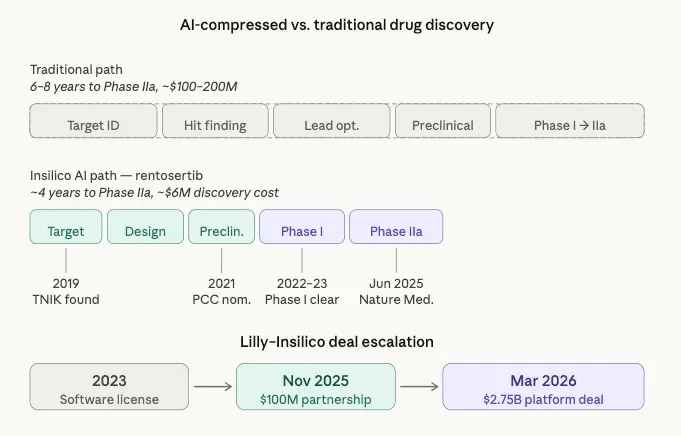
The first Weekly Briefing opens on the deal that reframes the whole category: Eli Lilly committing up to $2.75 billion to license AI-discovered drugs from Insilico Medicine — an order of magnitude above any prior AI-pharma partnership. The structure matters more than the number. Lilly is licensing across a platform, not cherry-picking a molecule, and doing it alongside its own $1 billion NVIDIA lab — a two-track "build and buy" bet on AI discovery capacity. Around that centerpiece, the same forces surface everywhere this week: agentic tools collapsing the biology-plus-ML talent barrier, the FDA and EMA sketching a transatlantic rulebook, and a Benchling report insisting the models are already good enough — it's the data plumbing that's failing.
Lead — Lilly bets $2.75B on Insilico, the largest AI drug discovery deal yet
DealsEli Lilly has committed up to $2.75 billion to license AI-discovered oral therapeutics from Insilico Medicine — $115 million upfront on March 29, the remaining $2.63 billion tied to milestones and royalties — dwarfing every prior AI-pharma partnership. The structural signal is that Lilly is licensing across Insilico's Pharma.AI platform (PandaOmics for targets, Chemistry42 for chemistry, InClinico for trial prediction), not a single molecule; it believes the engine can repeatedly produce clinical-quality candidates. The confidence traces to rentosertib, the first drug whose biological target (TNIK) and molecule were both found by generative AI, which delivered a +98.4 mL FVC improvement versus a -20.3 mL decline on placebo in a 71-patient IPF Phase IIa. Read alongside Lilly's own $1B NVIDIA lab, this is a "build and buy" play — vertically integrating an external discovery engine while developing proprietary capability. The harder, unasked question: if AI compresses per-candidate cost toward single-digit millions, the pricing regime built on ruinous R&D costs starts to look exposed.
PandaClaw: agentic AI enters the target-discovery lab
Product launchInsilico launched PandaClaw, an autonomous agent embedded in PandaOmics that lets biologists run complex multi-omics analyses in plain language, no computational training required. It integrates 140+ scientific skills and 1,000+ bioinformatics tools, plans multi-step workflows, and returns publication-ready reports with statistical validation and data provenance — built on LangChain and LangGraph, self-correcting in a sandbox before returning results. The real leverage isn't the technology but the addressable user base: PandaOmics was gated behind rare dual biology-plus-ML expertise, and PandaClaw drops the barrier to anyone who can type a question. That expands both Insilico's potential customers and the speed at which partners like Lilly can run target-discovery campaigns internally. Expect rival platforms to ship agentic interfaces within months — the co-scientist pattern is about to become table stakes.
FDA and EMA set the first joint AI principles
RegulatoryOn January 14, the FDA and EMA jointly released "Guiding Principles of Good AI Practice in Drug Development" — 10 shared principles spanning the full lifecycle, from nonclinical research to post-market surveillance. It's the first coordinated transatlantic framework for AI in pharma: high-level rather than binding, but a clear signal of where both agencies expect the rules to land, covering human-centric ethical design, risk-based performance assessment, data governance and cybersecurity, and model lifecycle management. It builds on the FDA's January 2025 draft guidance on AI credibility frameworks (expected to finalize in Q2 2026) and the EMA's first qualification opinion on an AI-inclusive trial methodology. The gap between principles and actionable compliance is exactly where sponsors get hurt. Companies filing INDs for AI-discovered candidates in 2026–27 that invest early in validation protocols and explainability documentation will have a material edge when binding guidance arrives.
Benchling's 2026 report: the models work — the data doesn't
Industry dataBenchling's 2026 Biotech AI Report finds the industry has crossed from piloting into operational deployment — the "builder" phase — with 80% of organizations planning to raise AI budgets and 23% expecting to double their spend. Mature, verifiable applications lead adoption: protein structure prediction is used by 73% of leaders and docking by 52%. But adoption collapses in the domains that actually differentiate — generative molecular design (42%), biomarker analysis (40%), ADME prediction (29%) — and the limiter is almost never the models: 55% cite poor data quality as the top reason pilots fail. The bottleneck has shifted from "can AI work in drug discovery?" to "can your organization feed it clean data at scale?" That reframes the challenge as organizational, not technical — rewarding the unglamorous investments in data harmonization, metadata standards, and instrument-to-cloud pipelines over another round of model selection.
FDA's internal assistant Elsa runs on Claude
RegulatoryThe FDA's agency-wide generative AI assistant, Elsa (Electronic Language System Assistant), built on Anthropic's Claude and launched in June 2025, is now operational across the agency for adverse-event summarization, label comparisons, clinical protocol review, code generation, and inspection targeting — all in a secure GovCloud environment that doesn't train on industry submissions. A separate agentic-AI challenge is pushing FDA staff to build autonomous solutions of their own. The notable shift is that the regulator is becoming an AI user itself, which will inevitably reshape how it evaluates AI-driven submissions.
Life sciences AI funding outpaces the broader biotech recovery
Industry dataAI-linked life sciences startups raised roughly $3.7 billion across 49 deals in Q1 2026, up 56% year-over-year, according to Longevity.Technology. That outpaces the broader biotech funding recovery, which has been slower to climb out of the 2022–23 trough — even as overall North American venture funding hit a record $252.6 billion in the quarter, per Crunchbase. The signal is concentration: capital is increasingly flowing to companies at the AI-biology intersection rather than to conventional biotech platforms.
DrugCLIP screens 10 million compounds in hours
PapersPublished in Science by Tsinghua University researchers, DrugCLIP uses deep contrastive learning to embed billions of compounds and thousands of protein pockets into a unified chemical space, enabling docking-free virtual screening roughly 10 million times faster than conventional methods. Both the tool and an accompanying database of 10,000 protein targets are freely available. It's a genuine productivity leap for early-stage hit identification — expect quick, widespread adoption by academic and industry teams that currently spend weeks on screening campaigns.
Lilly-NVIDIA's $1B AI lab ramps up in South San Francisco
DealsThe Lilly-NVIDIA co-innovation lab announced at JPM26, backed by a joint $1 billion five-year investment, is now actively staffing and building out in the Bay Area. It co-locates Lilly domain experts in biology and medicine with NVIDIA AI engineers, using NVIDIA's BioNeMo platform and latest-generation GPU architecture to train large biomedical foundation models. The scope reaches well past discovery into clinical development, manufacturing (including digital twins of production lines), and supply chain. Paired with the Insilico licensing deal, it's the clearest evidence Lilly is running a two-track "build and buy" AI strategy simultaneously.
Help shape this newsletter — five quick questions, under a minute. Give feedback →