Isomorphic enters the clinic — and why data, not models, will be the moat
Isomorphic Labs gears up for human trials, Owkin's "AI scientist" lands at three top-ten pharmas, and Bessemer makes the case that biology-native data is the only durable advantage.
The benchmark era of AI drug discovery is ending, and 2026 is where the field's biggest theses meet real clinical and commercial tests. Isomorphic Labs is finally gearing up to put AI-designed molecules into human trials, Owkin's agentic "AI scientist" has landed inside three top-20 pharmas, and Bessemer has published the sharpest argument yet for why most AI biotechs will lose. The connective tissue across all three is data: proprietary, biology-native, clinically-tied data is emerging as the durable moat while models commoditize. This issue tracks who is building that flywheel and who is still selling model-layer promises.
Lead — Isomorphic Labs finally gears up for human trials
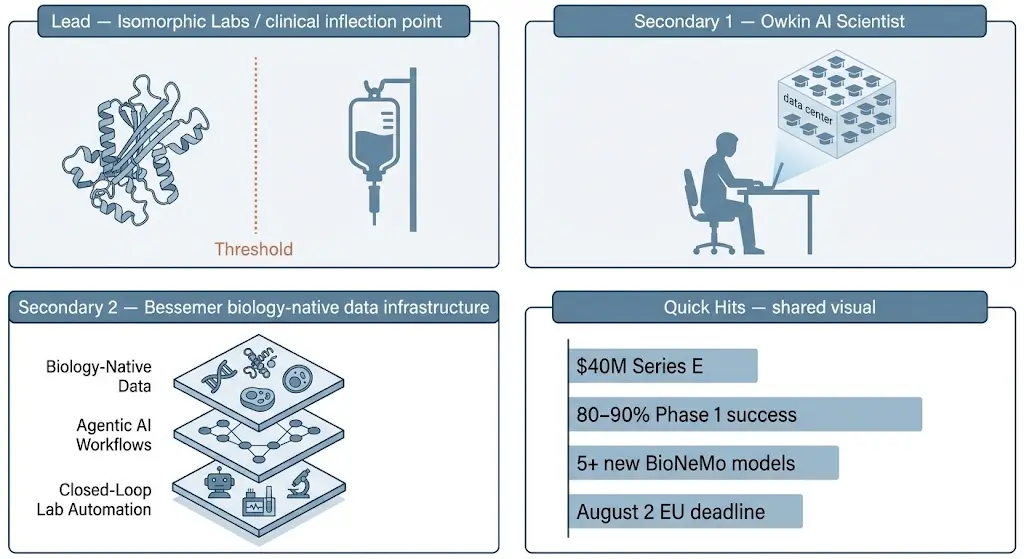
OpinionAt WIRED Health in London on April 16, Isomorphic Labs president Max Jaderberg confirmed the Alphabet/DeepMind spinoff is preparing to put its first AI-designed molecules into oncology and immunology trials, engineered for high efficacy at lower doses. The pipeline stacks AlphaFold's structure prediction with IsoDDE, the company's drug-design engine, which it claims doubled AlphaFold 3's accuracy on the hardest generalization benchmarks and predicted a hidden cereblon binding pocket from sequence alone. But the timeline pattern invites scrutiny: Hassabis promised human trials by end of 2025, then end of 2026 at Davos, and now only "gearing up" with no date. With a $600M raise and partnerships with Lilly, Novartis, and J&J worth a potential $3B-plus, the 2026 readout is the most consequential validation the AI drug-design thesis will face. The real question isn't benchmarks — it's whether Isomorphic can build a fast clinical-data-to-model loop rather than an expensive way to generate standard Phase 1 failures.
Owkin's agentic AI scientist deploys across three top-20 pharmas
DealsPer BioPharma Dive, Owkin has deployed an autonomous "AI scientist" across Sanofi, Bristol Myers Squibb, and Merck & Co., operating end-to-end on commercialization, target-discovery, and trial-design questions rather than as a copilot. Co-CEO Pascal Weinberger pitched it as giving every researcher "a data center full of genius PhD students in their pocket" — and, crucially, as pipeline capacity, not per-seat productivity. The framing implies identical headcount managing 10x more programs, shifting the bottleneck from analytical capacity to deal flow. It arrives amid broader agentic momentum, including Anthropic's $400M Coefficient Bio acquisition and Claude for Life Sciences connectors into Benchling and PubMed. The honest counterweight: most pharma failures are biological, not analytical, so the real enterprise question is which actual decisions the tool has changed.
Bessemer's thesis on why most AI biotechs will lose
OpinionIn a new Atlas piece, Bessemer's Andrew Hedin, Marla Jalbut MD, and Grace Dai lay out a three-principle framework for biology-native data infrastructure: curate scalable multi-modal datasets tied to mechanism of action, embed agentic AI across R&D, and adopt lab automation for closed feedback loops. The sharpest data point is structural — 63% of biology AI models train on protein sequence and structure from UniProt and the PDB, which is heavily biased toward stable, crystallizable proteins and thin on the membrane proteins, disordered proteins, and transient complexes that drive oncology and neurodegeneration. The implication: commercially important predictions correlate with the weakest data, so models commoditize while data doesn't. Bessemer names Peptone, Inductive Bio, Converge Bio, NOETIK, and Prima Mente as data-first exemplars. The uncomfortable takeaway is that middle-position, model-layer AI biotechs are the hardest to defend as moats migrate down to data and up to workflow.
Alloy Therapeutics raises $40M Series E at $1B valuation
FundingBoston-based Alloy Therapeutics closed a $40M Series E at a $1B valuation, framing the round as a pivot from antibody discovery to "full-stack biotech infrastructure" spanning AI/ML models, real-world data, and integrated wet-lab services across 200-plus partners and 22 clinical-stage programs. A unicorn valuation on a $40M raise is unusual and reads as brand maintenance over capital necessity. The infrastructure framing is sound, but it puts Alloy in direct competition with Benchling, Schrödinger, and Amazon Bio Discovery on platform breadth — a much harder fight than antibody discovery alone.
PitchBook: AI-native biotechs claim 80–90% Phase 1 success
Industry dataA January 2026 PitchBook analysis via BioSpace reports AI-native biotechs hitting Phase 1 success rates of 80–90%, versus an industry baseline of 40–65%, plus 40% Phase 2 success against 29% for industry. It's the first quantitative signal the AI thesis is delivering — but the dataset is only 10 trials. AI-native programs are also disproportionately early, well-funded, and target-rich relative to industry averages, so the gaps may narrow. The honest test is whether the advantage persists at n=50 trials matched by indication and target class, a metric worth monitoring through 2027.
NVIDIA expands BioNeMo with new partner models
Product launchAt GTC, NVIDIA expanded its BioNeMo catalog with partner models including Basecamp Research's EDEN family for large-DNA-segment insertion, Boltz Lab's molecular design models, Chai Discovery's biomolecular foundation models, and Natera's cancer foundation model. NVIDIA also shipped its own RNAPro for RNA structure prediction and ReaSyn v2 for synthesis feasibility. BioNeMo is becoming the AWS Marketplace of biology AI — broadly useful, defensible nowhere. NVIDIA's real strategic asset is GPU lock-in for training; the model catalog is bait.
EU AI Act high-risk provisions take effect August 2
RegulatoryThe EU AI Act's high-risk provisions take effect August 2 and could classify certain drug-development AI as "high-risk," adding auditability, transparency, and reproducibility requirements for pharma AI submissions, per Drug Target Review. Critically, the guidance targets AI affecting regulatory decisions and explicitly excludes early discovery, so most current AI drug discovery falls outside its scope. Expect this to be the biggest perception-reality gap in pharma AI compliance over the next 12 months — EU pharma teams are quietly relieved while their consultants are quietly disappointed. Watch for guidance updates extending scope to clinical-stage AI tools, where the real ambiguity sits.
Help shape this newsletter — five quick questions, under a minute. Give feedback →