The Allen Institute wants to turn 20 years of brain maps into medicines
A $200M Brain Health Accelerator division applies the institute's cell-type atlases to gene therapies for Alzheimer's, Parkinson's, Huntington's, and ALS. Plus: Mayo AI at ASCO, an ex-Palantir team building pharma AI orchestration, and the week's autonomous-research debate.
This issue's throughline is AI moving upstream — out of the molecule-design lane and into the maps, workflows, and research loops that surround it. The Allen Institute is turning twenty years of brain atlases into a $200M gene-therapy unit; ex-Palantir founders are betting pharma's real gap is orchestration, not another generative model; and Mayo is quietly making AI standard-of-care at the diagnostic layer. Meanwhile the "can AI do science?" debate hardens from capability into a governance question, and journals of record begin publishing procurement guidance for autonomous agents. The bottleneck is shifting from target ideas to targeting precision, provenance, and trust.
Lead — Allen Institute's $200M turn from mapping the brain to treating it
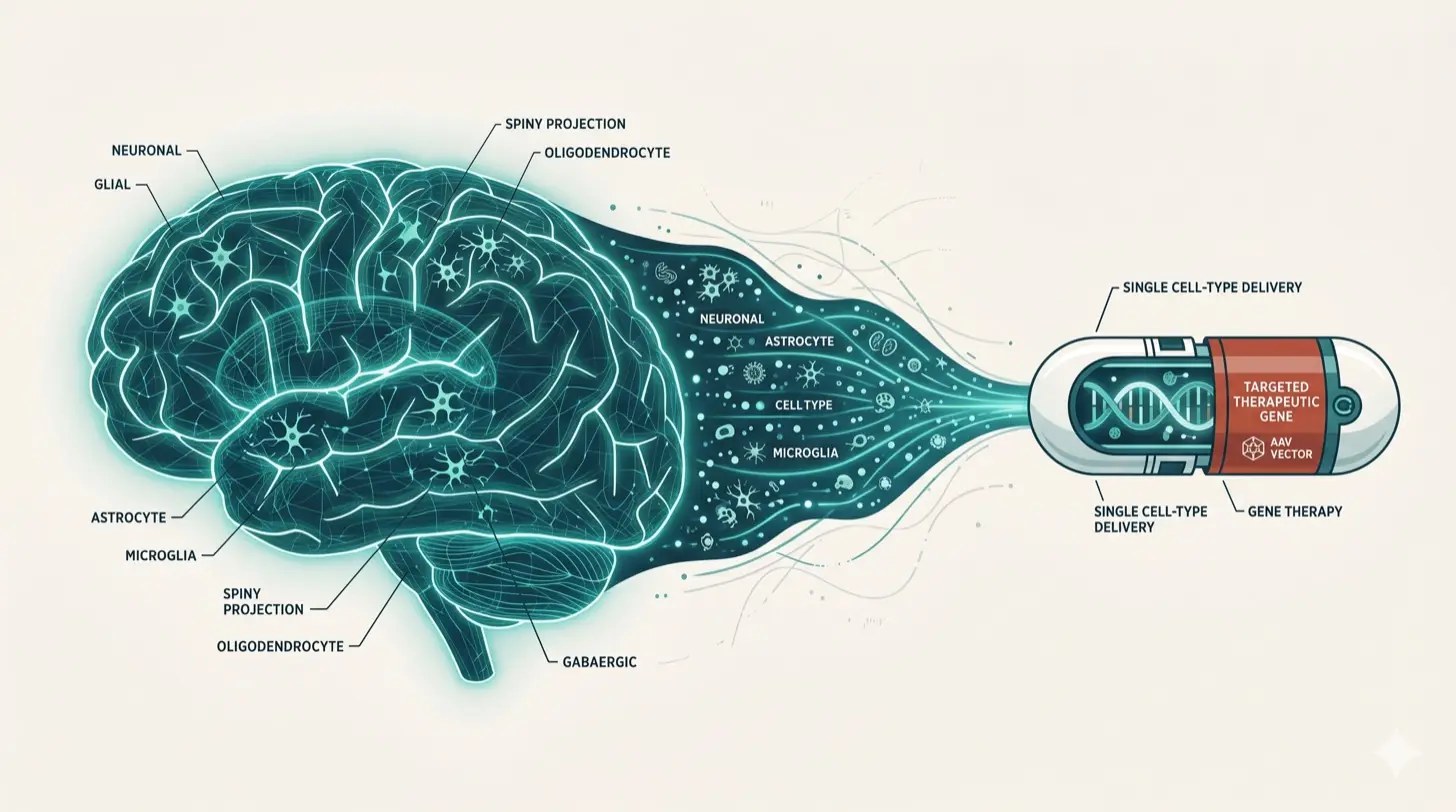
FundingThe Allen Institute — the Seattle nonprofit that spent two decades mapping the human brain cell by cell — unveiled the Brain Health Accelerator on June 2, a $200M division to develop gene therapies for Alzheimer's, Parkinson's, Huntington's, and ALS. It is the first time since the institute's 2003 founding that treating disease, rather than understanding it, is the explicit mission. The foundational asset is its single-cell transcriptomic atlas work, paired with cell-type-specific promoters and engineered AAV capsids to deliver payloads with cell-type precision instead of blunt CNS-wide dosing — the AI operating upstream, in the map itself. Funding comes from the roughly $3.1B Fund for Science and Technology seeded by Paul Allen's estate; the unit starts near 60 people and expects to scale toward 200 on a decade-scale horizon. The signal for CNS investors and BD teams: the bottleneck is shifting from target ideas to targeting precision, and the precision comes from the map.
Mayo Clinic pushes AI into the diagnostic layer at ASCO 2026
Industry dataMayo Clinic presented 30+ studies at ASCO 2026 with AI concentrated in early detection and tumor-microenvironment analysis rather than drug design. Highlights included AI-enabled tumor microenvironment analysis in colon cancer, results from PATHFINDER 2 — a registrational multicancer early-detection study in an intended-use population (Abstract LBA10509) — and an AI-adjacent endometrial cancer test from vaginal-swab analysis. The read: clinical AI's center of gravity is shifting toward diagnostics and early detection, the segment with the clearest reimbursement and volume opportunity. When a flagship academic center, not just startups like Tempus, productionizes AI on routine pathology and screening, it normalizes AI as standard-of-care infrastructure.
Ex-Palantir team raises $12M for pharma's missing operating system
FundingPerceptic, founded by former Palantir staff, raised a $12M seed to build an orchestration and workflow layer for pharma R&D rather than another molecule-design model. It is a contrarian bet: the molecule-generation lane is crowded and capital-saturated (Isomorphic's $2.1B, Insilico's Lilly deal), so Perceptic is wagering the unmet need is the connective tissue unifying fragmented data, tools, and decisions. The "Palantir-for-pharma" framing has been attempted before with mixed results. The differentiator will be whether an outside team can navigate the validated-systems and data-governance realities that have humbled generic platform plays.
"Can AI do scientific research?" becomes the week's defining question
OpinionEndpoints' weekly flagship led with the autonomous "AI scientist" debate as systems claiming to compress months of research into a day move from demo to discourse. The narrative is shifting from "AI designs the molecule" to "AI runs the research loop" — hypothesis generation, experiment design, analysis. Momentum comes from Edison Scientific's Kosmos, with its debated "six months of work in a day" claim, and Robin, a multi-agent hypothesis-and-analysis system published in Nature, alongside a Nature Methods survey that reads more like a cautious buyer's guide than a celebration. For R&D leaders the operative question is no longer capability but governance: reproducibility, provenance, and what an "AI-generated finding" means in a regulatory file.
Verge Labs turns a failed ALS trial into a proprietary dataset
Industry dataVerge Labs is publishing the analysis of its failed ALS trial and folding that data into its training set. The company is treating clinical failure as a labeled, proprietary dataset rather than a write-off. The thesis: whoever systematically monetizes failure data gains a real competitive edge, since negative results rarely make it into shared corpora.
ASCO becomes the AI curator with a new oncology hub
Product launchASCO and Conexiant launched "ASCO AI in Oncology," a curated digital hub for the specialty. When the specialty society itself becomes the AI curator, the trust layer forms in real time — the tools and claims it chooses to anoint will shape what the field treats as credible. Worth watching which vendors and results get surfaced.
Nature Methods publishes procurement guidance for AI agents
PapersNature Methods ran "Call your AI agent," a survey of autonomous-analysis agent systems. The methods-journal-of-record publishing what amounts to procurement guidance signals that agents have crossed from conference demo to lab-budget line item. Reading like a cautious buyer's guide, it reframes the question from whether these agents work to which one a lab should actually adopt.
Nature Machine Intelligence calls for explainable protein-design AI
OpinionA Nature Machine Intelligence perspective calls for explainable, safer protein-design AI. The framing: the black-box problem is the regulatory rate-limiter, not an academic footnote — "trust us, the protein folds" doesn't clear an IND. As generative protein design scales, interpretability becomes the gating requirement for anything headed into a regulatory file.
The Onion Desk
The satire desk skewers the week's AI-in-medicine themes. A new agentic clinical platform identifies optimal therapy in 0.3 seconds, then spends 40 minutes and a 12-paragraph disclaimer explaining it cannot legally tell anyone. A foundation model surfaces a natural-killer-cell signal in a bone-marrow slide personally signed off in 2019, which pathologists insist they'd "totally have seen eventually." A pancreatic-cancer chemo-picking algorithm gets forwarded the Q3 budget and the parking situation, and a study finding online medical-AI information is low-quality ends with patients pasting it into a chatbot — "a closed loop of mediocre explanation."
Help shape this newsletter — five quick questions, under a minute. Give feedback →